
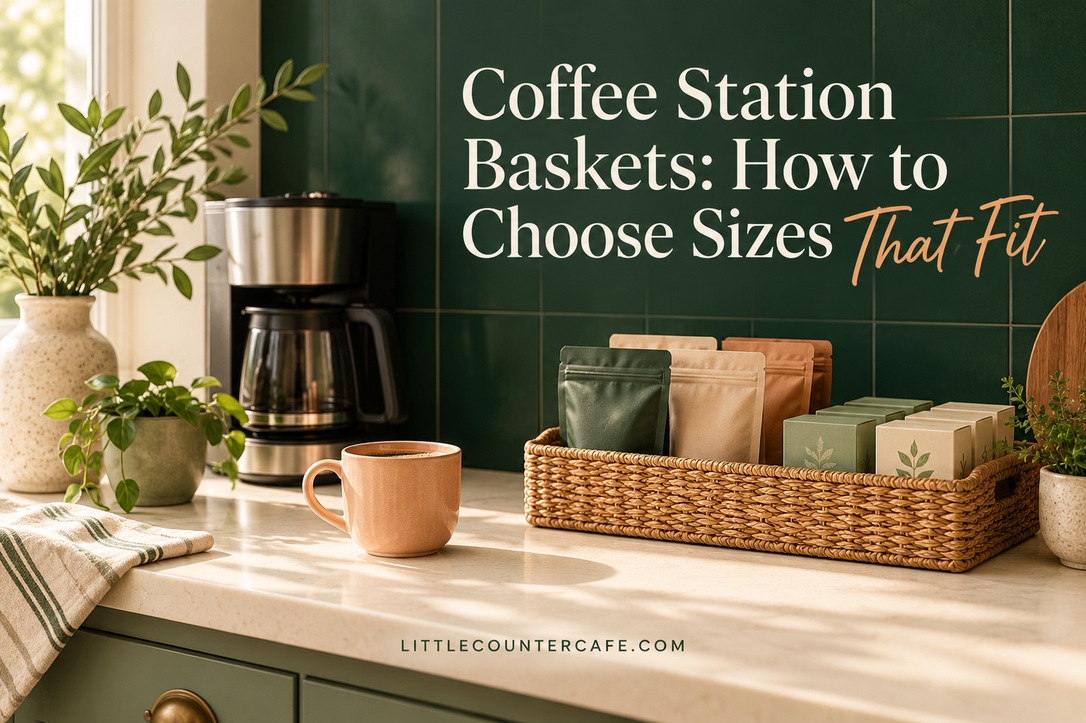
A coffee station basket needs to pass two different tests: it must fit its spot, and your everyday supplies must fit inside it. A basket that slips onto a shelf can still be awkward if its handles catch, its base is too narrow for your coffee bag, or you have to unload half of it to find the tea.
I like storage that makes the first cup feel simple. Start with the coffee and tea supplies you actually reach for, measure their intended home, and choose one basket before committing to a matching set. The prettiest option is useful only if you can comfortably reach, lift and refill it.
This is a planning guide with illustrative examples, not a measured installation or a hands-on basket review. Use the free two-page Coffee Basket Fit Worksheet to record your own opening, supplies and trial fit. The styled images are inspiration rather than proof that a particular product fits your cabinet.
Measure the Space the Basket Must Fit
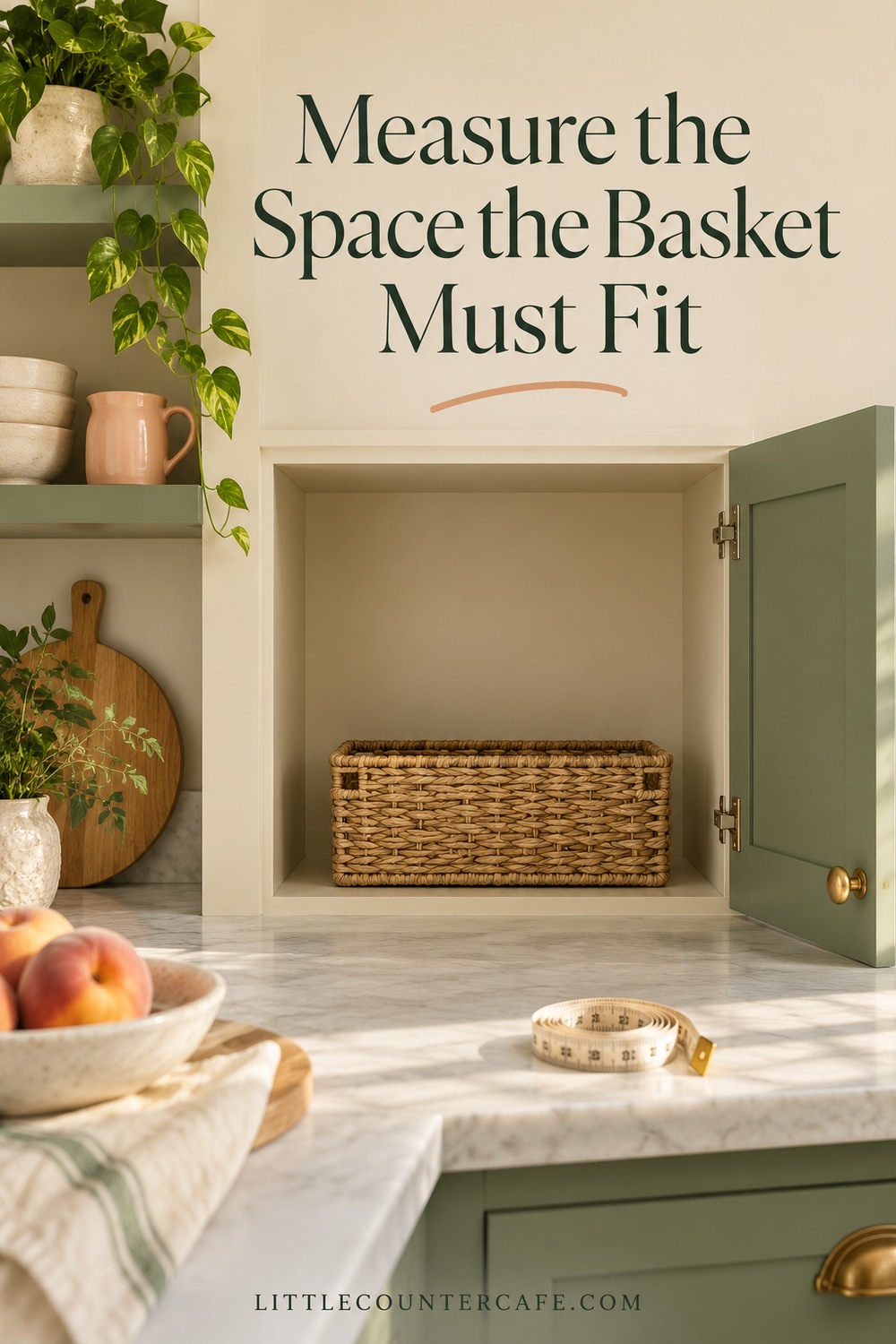
Measure the clear opening where the basket will live, not the furniture’s overall width. Inside a cabinet, the opening may be narrowed by hinges, a door that does not swing fully back, a center support or a shelf lip. On a counter, the available space begins after you have allowed for the coffee maker’s operating area and your drink-preparation space.
Record three measurements in the orientation you intend to use: left-to-right width, front-to-back depth and shelf-to-obstruction height. Measure at the front and farther back if the opening changes. Use the smallest clear measurement as your starting limit, and note the obstruction rather than hiding it in a rough average.
Then measure the basket at its widest external points. A flared rim, woven seam or side handle can project farther than the base. Include handles in their stored position and ask whether the seller’s stated height includes them. Wovenhill’s own measuring guidance specifically calls out lids and handles and warns that its handmade products can vary. Its stated tolerance belongs to those products; do not apply it as a universal allowance for every basket.
Leave space for the action, too
A basket must move through the opening. Think about how you will grip it, slide it forward, lift it over a lip or reach over its rim. There is no single gap that works for every hand, handle and shelf. Test the movement with a similarly sized container rather than choosing a clearance by appearance alone.
Keep the base fully supported. A basket that hangs over the edge can become awkward to pull out, especially when loaded. Check the shelf’s rating and the basket’s own load guidance; a large empty volume does not mean it is suitable for heavy mugs or bottles. Avoid storing a heavy basket high overhead.
For two baskets side by side, add both maximum outside widths, the intended gap between them and the side spaces you need for access. As an illustrative calculation, two 7-inch baskets total 14 inches before any gaps. They should not be ordered for a 14-inch opening on that calculation alone. Repeat the exercise in centimeters if that is how your seller lists sizes, keeping one unit consistent throughout.
If the coffee maker already fills the counter, use a nearby cabinet for the basket. Our guide to what to keep on a coffee counter can help you reserve the surface for daily work.
Check the Usable Space Inside the Basket
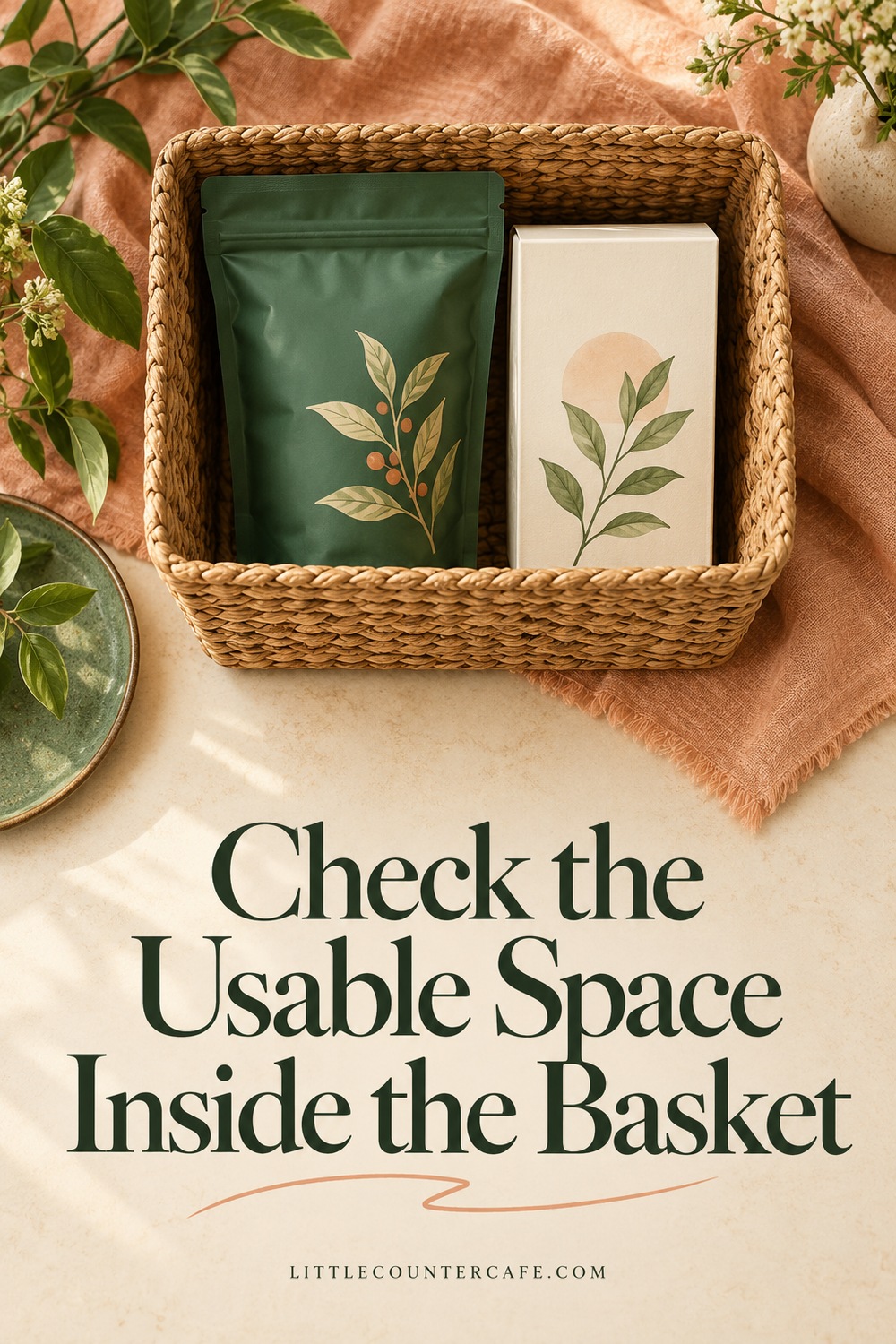
Outside dimensions tell you about placement. Inside dimensions tell you about capacity. Thick woven walls, a sloping side, a liner or a divider can make the useful base considerably smaller than the rim. A coffee pouch that fits across the open top may not stand flat at the bottom.
Gather the exact items that will go inside: your coffee bag, the tea box you keep buying, sealed pods, filters or clean teaspoons. Stand or lay them as you intend to store them and measure the group. Include mug handles if you are considering mug storage. Do not use the width of the cup alone.
Ask for internal base width and depth when buying a tapered basket, plus usable height if the contents must stay below a shelf. If these measurements are absent, treat capacity as unconfirmed. A product photograph and a capacity in liters cannot establish whether a rigid tea box will fit flat.
Read the product diagram, not just the size name
Small, medium and large are labels, not standardized coffee-storage sizes. Confirm which listed number means length, width and height, and distinguish product measurements from shipping-package measurements. IKEA’s RISATORP listing, for example, separately gives product dimensions and packaging dimensions. Its listed basket size is 9 3/4 by 10 1/4 by 7 inches; that does not establish an internal rectangular space of the same size or prove it fits your shelf.
The purpose of that example is to show how to read a listing, not to recommend that particular basket for every coffee corner. Recheck the current product diagram, handle arrangement and care instructions before choosing a variant.
Allow room to grasp the item you want without tipping neighboring containers. A basket packed tightly enough for a photograph may be frustrating when you need one tea bag with your other hand holding a mug. For loose packets, a small upright divider can help, provided it does not consume the space you measured for the contents.
Keep coffee in suitable sealed packaging or a suitable closed container inside the organizer. An open decorative basket is an organizer, not a substitute for appropriate food packaging. Avoid transferring loose coffee or unwrapped food into an unknown basket material simply because it looks convenient.
Choose a Shape That Suits Your Supplies
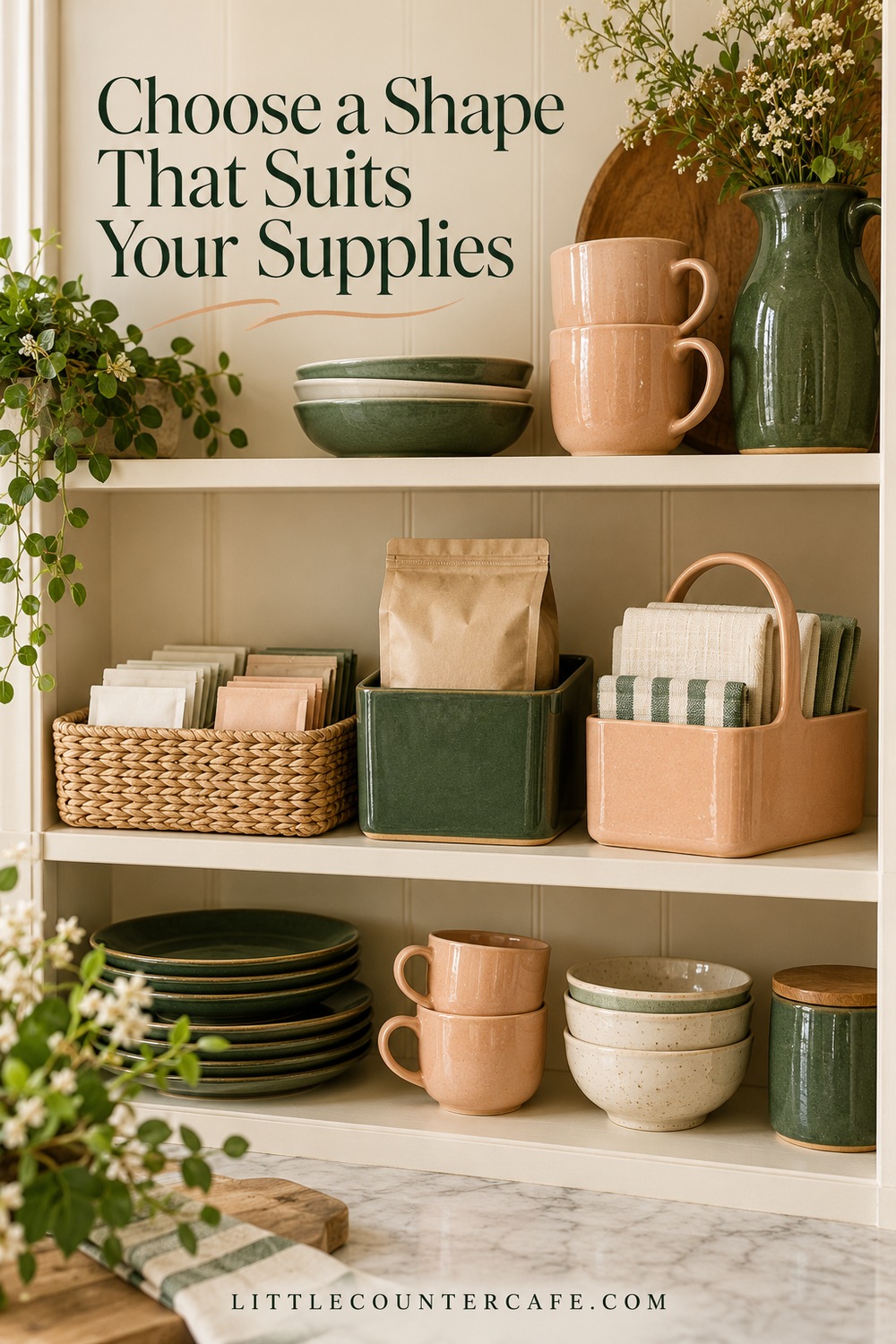
Give the basket one clear job before choosing a material. A low counter basket might gather a small daily supply of tea and coffee packets. A deeper cabinet basket might hold unopened backup supplies. A guest caddy can bring napkins and sweeteners to the table, then return to storage. Trying to combine all three jobs often creates an oversized basket that is heavy and difficult to search.
Match the shape to the task
- Low rectangular basket: useful when you want to see short packets and reach from above. Check that the sides are high enough to contain the items when moved.
- Straight-sided bin or basket: worth considering for rigid boxes and predictable shelf layouts. Check actual internal dimensions rather than assuming straight sides eliminate lost space.
- Handled caddy: practical for supplies you carry elsewhere. Test the handle grip with the intended load, and keep hot drinks separate from a supply basket.
- Deep basket: better considered for a defined group of lightweight reserve items than for a mixed pile of tiny everyday accessories.
Wire makes contents visible, but small packets or narrow tools may catch or slip through an open grid. Woven material adds warmth, but its texture and seams can change the usable space. Fabric sides may bulge when loaded, so an empty basket’s measurements are not enough for a snug opening. A removable liner also takes up room and has its own care instructions.
Choose a base that will sit steadily and will not mark the surface underneath. Check for rough edges and follow the basket maker’s care guidance. Do not assume that wire or plastic means dishwasher-safe. IKEA’s RISATORP care instructions, for instance, specify wiping and drying and prohibit dishwashing or submerging that model. Other products may have different instructions.
Keep baskets clear of hot surfaces, appliance vents, steam paths and cords. Store syrup bottles only if the basket supports them upright and the combined load is suitable; a washable tray may be easier for sticky drips. Keep a damp cloth out of woven storage and let any cleaned components dry as their instructions require.
For a small budget, begin with a basket you already own or buy a single trial basket. Matching color and texture can make different sizes feel related. You do not need a full matching set to make your counter look considered. Our daily and backup supplies guide helps decide which job each basket should do.
As an Amazon Associate I earn from qualifying purchases. The accompanying storage favorites list contains paid links. Compare dimensions and materials against your worksheet before buying anything.
Test the Fit Before Buying a Full Set
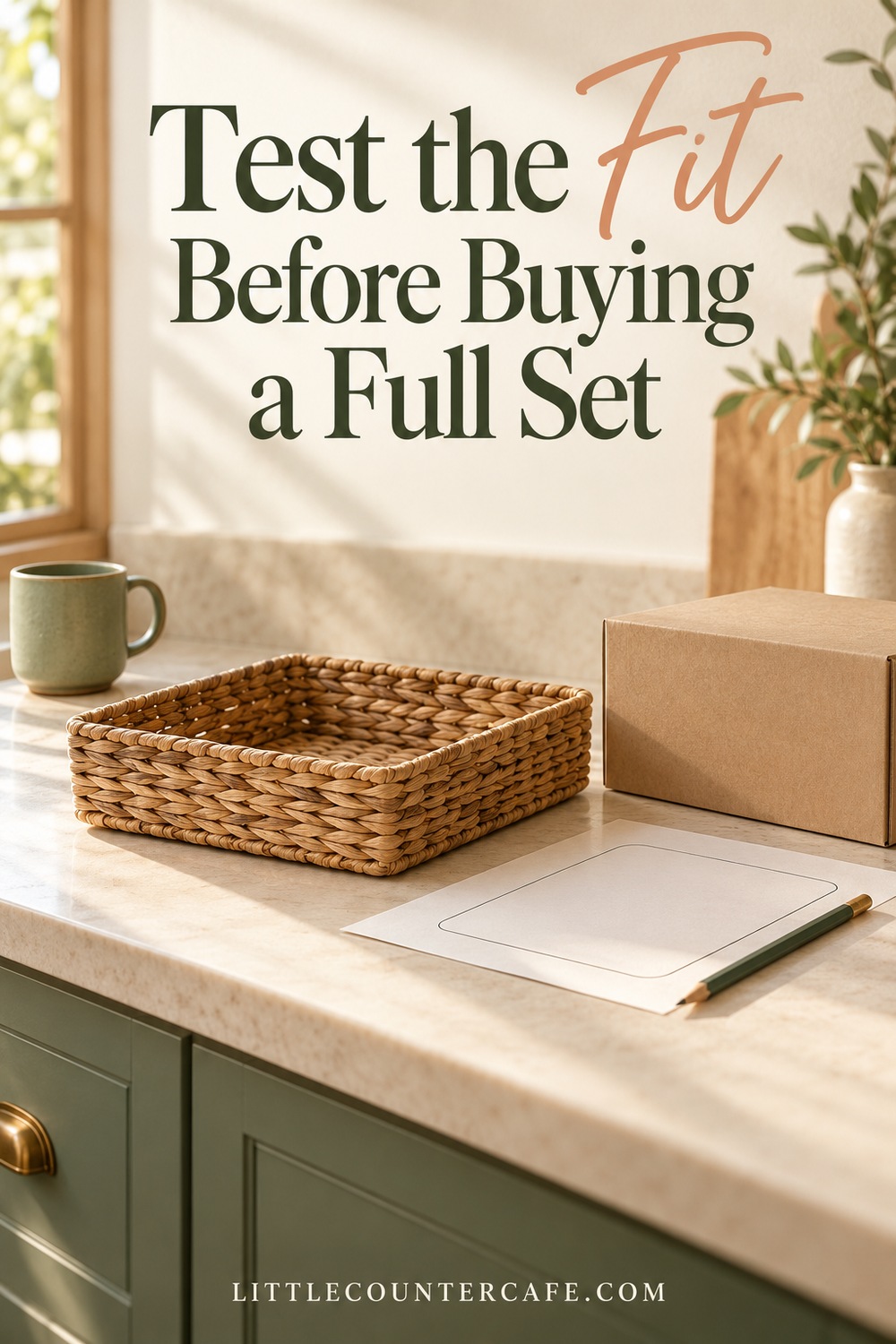
Make a paper footprint using the proposed maximum outside dimensions. Place it where the basket would sit and check neighboring appliance access, cabinet movement and countertop working room. A flat template checks the footprint only. Use a cardboard box or folded cardboard sides to explore height, handles and the path out of a shelf. Do not use a paper mockup as a load or heat test.
Next, use the actual supplies to test the proposed internal footprint. Mark a second, smaller rectangle for the usable base if the seller provides it. Arrange the contents without forcing or crushing packaging. If the interior measurements are missing, write “ask seller” rather than recording a guess as confirmed fit.
When your first basket arrives, try it empty, then load it gradually within the product and shelf limits. Check that you can close the door, grip the basket, bring it forward and return it without snagging. Try reaching your usual tea or coffee item. If you must remove several unrelated things first, change the grouping or use a lower basket.
A quick pass-or-revise check
- Does it pass through the narrowest opening, including hinges and handles?
- Is the whole base supported, with room for your chosen grip and movement?
- Do the real supplies fit inside at the base, not just across the rim?
- Can you see and retrieve the daily items comfortably?
- Is the loaded basket manageable, suitable for its surface and within stated ratings?
- Can you clean it according to its own instructions without making the surrounding coffee area harder to maintain?
If one answer is uncertain, pause before ordering the rest. A smaller basket, a shallower shape or two separate supply groups may solve the problem more simply than rearranging the whole station. Record the successful model, variant and measured dimensions so a later purchase is based on your actual fit.
Download the Coffee Basket Fit Worksheet for a measurement page and a trial-fit checklist. Keep it with your shopping notes and compare one candidate at a time. Start with the basket’s everyday job, then choose the size that makes that job easy.
Sources and further reading
- Wovenhill: How to Measure a Basket explains its measurement axes, handle/lid considerations and handmade variation.
- IKEA: RISATORP wire basket, article 902.816.18 provides a current example of separate product/packaging measurements and model-specific care instructions.
LITTLE COUNTER CAFE · Coffee & Tea Storage Favorites
A calmer counter starts with a place for everything.
Canisters, tea storage, shelf organizers, and small accessories to keep everyday café supplies easy to reach.
As an Amazon Associate I earn from qualifying purchases. This is a paid link.